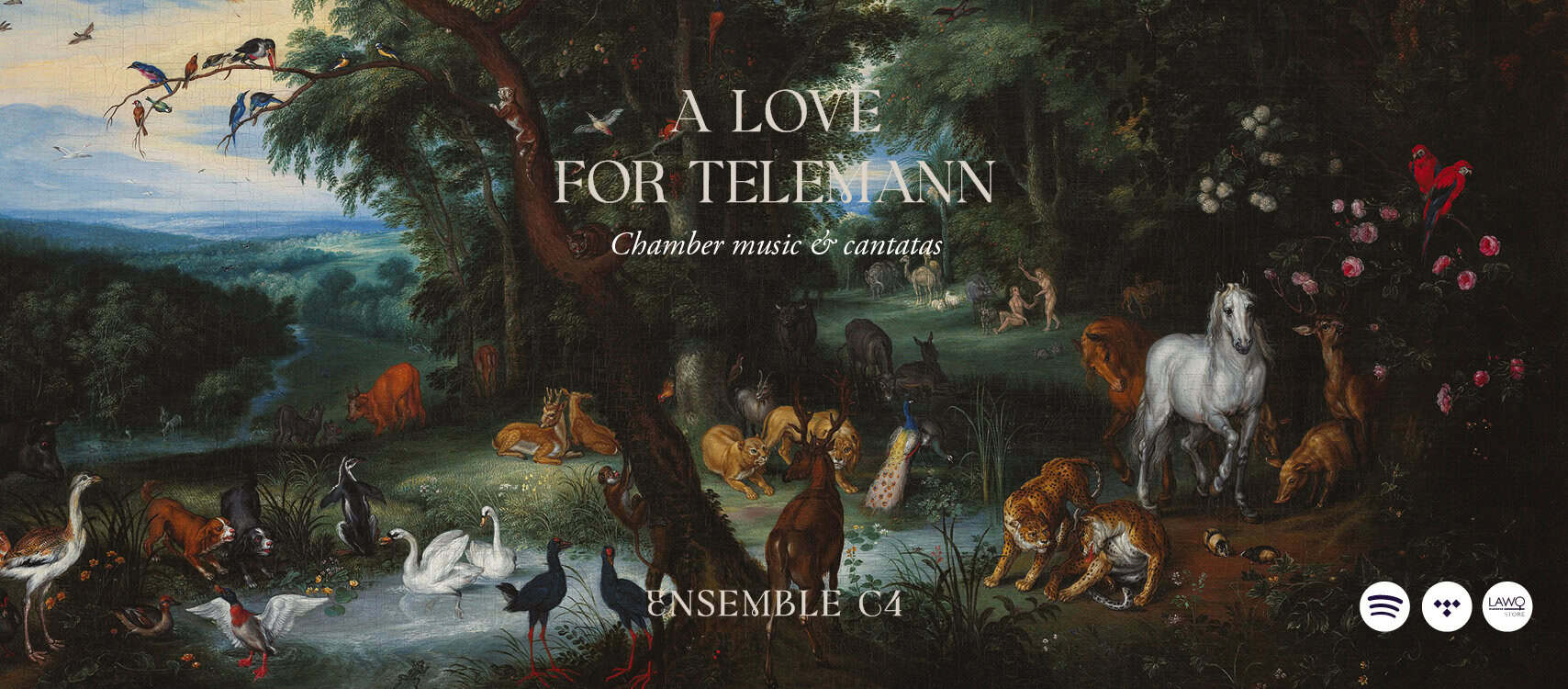
With a deep understanding of historical performance and a passion for musical exploration, the Norwegian ensemble Ensemble C4 breathe new life into the compositions of Georg Philipp Telemann, revealing the extraordinary creativity behind one of the Baroque period’s most fascinating musical voices.
Some composers leave behind a musical legacy that continues to challenge and inspire generations of performers. Georg Philipp Telemann is undoubtedly one of them. His compositions combine technical imagination, emotional expression and an openness that gives musicians remarkable freedom. It is precisely this spirit that Norwegian Baroque ensemble Ensemble C4 embrace in their album A Love for Telemann, released through LAWO Classics.
Rather than simply revisiting familiar Baroque repertoire, Ensemble C4 approach Telemann’s music as an opportunity for artistic discovery. Their recording brings together chamber music and cantatas, creating a programme that moves between instrumental virtuosity, intimate storytelling and the expressive possibilities of the human voice.
The result reflects something fundamental about the ensemble itself: a belief that historical music should remain a living, evolving art form.
A composer who understood the musicians
Born in Magdeburg in 1681, Georg Philipp Telemann was among the most prolific composers of the Baroque era. His musical journey took him through several important German cities before he settled in Hamburg in 1721, where he served as cantor until his death in 1767.
His influence extended across Europe, not only through his compositions but also through his successful publishing activities. During his lifetime, many contemporaries regarded his musical achievements as exceptional. His ability to explore different forms, styles and instrumental combinations made him a distinctive figure in European music.
For Ensemble C4, Telemann’s appeal goes beyond his historical importance. His compositions invite performers to become active participants in the creative process. The music offers structure without restricting imagination, allowing individual interpretation, spontaneity and personality to shape every performance.
This is particularly important in Baroque music, where the relationship between composer and performer plays a central role in bringing the score to life.
An album built on musical conversation
A Love for Telemann explores different dimensions of the composer’s work through a carefully selected programme.
The recording features three chamber compositions, including the Trio Sonata in G minor, TWV 42:g9, the Sonata without Bass in G minor, TWV 40:104, and the Trio Sonata in F major, TWV 42:F3.
These works demonstrate Telemann’s remarkable understanding of instrumental character. Different instruments enter into dialogue, exchanging musical ideas and creating textures that balance elegance, technical complexity and expressive freedom.
The album also explores his vocal repertoire through two cantatas from Harmonischer Gottesdienst: Jauchzet, frohlocket! der Himmel ist offen, TWV 1:953, and Kein Vogel kann im weiten Fliegen, TWV 1:994.
Performed by Norwegian countertenor Daniel Sæther, these compositions transform religious reflections and moral questions into intimate musical dramas. The combination of voice, obbligato instruments and continuo gives the texts an expressive dimension that extends beyond their words.
The programme also includes Telemann’s Missa brevis, TWV 9:14, demonstrating his ability to bring invention and vitality to traditional sacred music.
Together, these compositions create a portrait of a composer whose musical imagination extended across instrumental and vocal traditions.
The musicians behind Ensemble C4
Founded in 2015 by recorder player Caroline Eidsten Dahl, countertenor Daniel Sæther and baroque violinist Ingrid Økland, Ensemble C4 has developed an artistic identity rooted in collaboration and curiosity.
The Norwegian ensemble works across early music and contemporary composition, exploring connections between historical traditions and modern creative approaches.
Over the years, the group has developed regular concert productions, received commissions and collaborated with important figures in Norway’s musical community. Its work has also extended beyond national borders, with an international concert debut in August 2024 through performances in the Venice and Trentino regions of Italy.
The ensemble’s collaboration with Norwegian composer Knut Vaage further illustrates its interest in bringing historical instruments and contemporary musical language together. Since 2020, they have premiered several of his works for countertenor and Baroque ensemble.
For this recording, the founding musicians are joined by an accomplished group of performers: Maria Ines Zanovello on violin, Henrikke G. Rynning on cello, Jadran Duncumb on lute and Baroque guitar, André Lislevand on viola da gamba and Christian Kjos on harpsichord.
Each musician contributes to the album’s rich instrumental character, creating an environment where individual expression and collective interpretation work together.
Keeping historical music alive
One of the most interesting aspects of Ensemble C4’s artistic philosophy is their understanding of authenticity.
For the musicians, performing Baroque music does not mean attempting to recreate an idealised version of the past. Instead, historical knowledge provides a foundation for new interpretations. The score becomes a starting point for musical exploration rather than a set of instructions that must be followed without question.
This approach allows the ensemble to connect historical performance practices with the experience and sensibilities of musicians working today.
It also explains why Telemann remains such a natural focus for their work. His compositions offer an unusual balance of precision and freedom, encouraging performers to explore sound, character and musical interaction.
Recorded at Grorud Church in Oslo between 13 and 15 January 2025, A Love for Telemann reflects this philosophy through a programme that celebrates both the composer’s legacy and the creative relationship between musicians.
A legacy that continues to inspire
With A Love for Telemann, Ensemble C4 offer listeners an opportunity to rediscover a composer whose contribution to Baroque music deserves continued attention.
The album is not simply a tribute to the past. It is a demonstration of how historical repertoire can remain relevant through thoughtful interpretation, collaboration and artistic curiosity.
For listeners familiar with early music, the recording offers a fresh perspective on Telemann’s chamber and vocal compositions. For those discovering his work for the first time, it provides an engaging introduction to a musical world filled with expressive detail, instrumental colour and creative possibility.
Ensemble C4’s greatest achievement is perhaps their ability to make this relationship between past and present feel natural. Through their performances, Telemann’s music becomes more than a historical record: it becomes a conversation that continues, inviting each new generation of musicians to contribute its own voice.